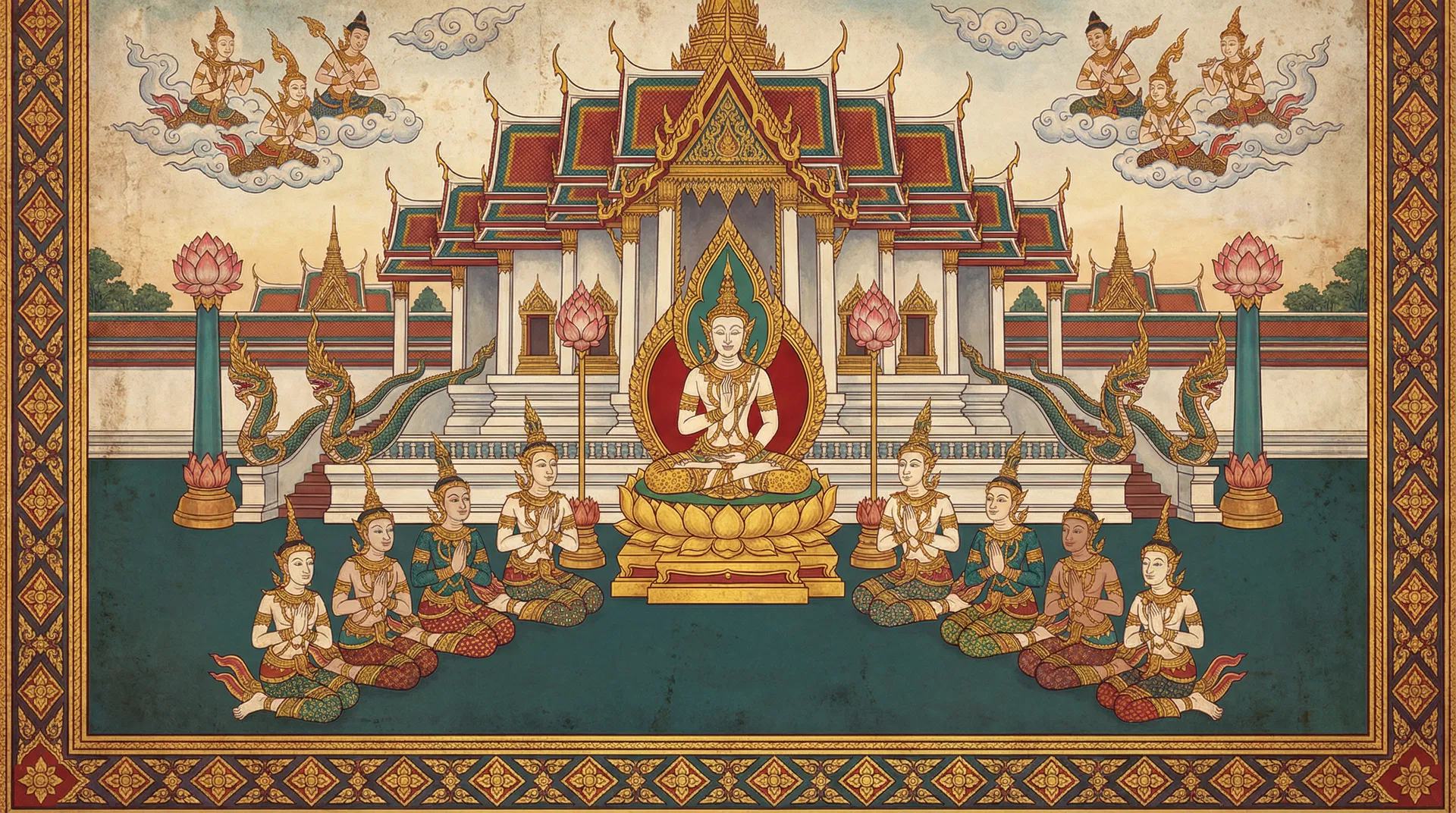
Asadisa Jataka
The Tale of the Unrivaled Gift
In the magnificent city of Savatthi, there lived a king named Supparaka. King Supparaka was renowned throughout the land not for his military might or his vast riches, but for his unparalleled generosity. His palace gates were always open to the needy, his granaries were always full for the hungry, and his heart was always overflowing with compassion.
One day, a humble mendicant, his body emaciated and his robes tattered, arrived at the city gates. He had traveled for many days, seeking alms, but had found little sustenance. His strength was failing, and despair was setting in. He heard tales of King Supparaka's boundless charity and made his way to the royal palace.
As he approached the palace, he saw a sight that filled him with awe. The king, dressed in simple attire, was personally distributing food to a long line of the poor and destitute. He spoke to each person with kindness, his eyes reflecting their suffering and his smile offering them hope.
The mendicant, his knees trembling, joined the end of the line. When it was his turn, he extended his alms bowl, his hand shaking. King Supparaka looked at him, his gaze gentle and understanding. 'My son,' the king said softly, 'you look weary. Have you eaten today?'
The mendicant, unable to speak, could only nod his head weakly. The king, without a moment's hesitation, took a large portion of the finest rice, mixed with ghee and fragrant spices, from his own plate and placed it into the mendicant's bowl. Then, seeing that the mendicant was too weak to walk, the king offered him a place to rest and a cool drink of water.
As the mendicant ate, his strength slowly returned. He looked at the king, his heart filled with gratitude. 'Your Majesty,' he said, his voice clear now, 'your generosity is truly unmatched. I have traveled far and wide, and I have never witnessed such selfless giving.'
King Supparaka smiled. 'It is not I who am generous, good sir,' he replied. 'It is merely my duty. True generosity is a gift that is given without expectation of return, without seeking praise, and without any thought of the giver's own comfort. It is a gift that springs from a heart that understands the interconnectedness of all beings.'
The mendicant, who was a Bodhisatta in a previous life, was deeply moved by the king's words and actions. He had seen countless acts of charity, but this was different. This was pure, unadulterated giving, motivated by compassion alone. The king's gift was not just food; it was a gift of love, a gift of shared humanity.
Later, the king was visited by a wealthy merchant who had heard of his legendary generosity. The merchant, a proud man who believed he was the most charitable person in the kingdom, brought a lavish gift of silks and jewels. 'Your Majesty,' the merchant declared, 'I have brought you the finest treasures. Surely, no one in this kingdom can match my generosity!'
King Supparaka accepted the gifts with a gracious nod. 'Your offerings are indeed magnificent, noble merchant,' he said. 'But tell me, when you gave these gifts, did you do so expecting something in return? Did you feel a sense of pride in your giving?'
The merchant puffed out his chest. 'Of course! I am a renowned patron of the arts and a pillar of the community! My gifts are known throughout the land!'
The king then recounted the story of the mendicant. 'I gave him my own meal,' the king explained, 'without any thought of reward or recognition. My only desire was to alleviate his suffering. That, merchant, is a gift that is truly unrivaled. For a gift given with a pure heart, expecting nothing in return, is the greatest gift of all. It is a gift that nourishes not only the recipient but also the giver, filling the heart with peace and contentment.'
The merchant, humbled by the king's wisdom, realized the difference between charity motivated by ego and true, selfless giving. He left the palace with a newfound understanding of generosity.
King Supparaka continued to rule with his extraordinary kindness, his acts of generosity becoming legendary. His unwavering commitment to giving without expectation, pure and simple, became the benchmark for true charity, a gift that enriched not only his kingdom but the spiritual landscape of all who heard his story.
— In-Article Ad —
💡Moral of the Story
True generosity is selfless and unconditional. It is given without expectation of reward, without seeking praise, and without any thought of the giver's own comfort. Such giving nourishes both the recipient and the giver, bringing peace and contentment.
Perfection: Generosity (Dana)
— Ad Space (728x90) —
More Jataka Tales You May Enjoy
 36Ekanipāta
The Tale of the Horse-Breeder
In a past aeon, in the flourishing city of Varanasi, the Bodhisatta was born as a young Brahmin, end...
💡 The highest form of virtue is selfless compassion, willing to sacrifice for the well-being of others.
433NavakanipātaNimi Jataka
Nimi JatakaIn the vibrant city of Mithila, nestled beside a flowing river and surrounded by fragrant...
💡 Virtuous actions and the cultivation of merit lead to happiness and favorable rebirths. True leadership involves not only ruling justly but also guiding one's people towards spiritual understanding and well-being.
 231Dukanipāta
Phra Ong Song Kaset Chatrakan (The Bodhisatta as the Royal Gardener)
Phra Ong Song Kaset Chatrakan (The Bodhisatta as the Royal Gardener) In the ancient kingdom of Mithi...
💡 True fulfillment comes not from forceful desire, but from patient cultivation of the right conditions and a loving heart. Nurturing what you have can lead to the blossoming of what you long for.
214DukanipātaSamukkita Jataka
The Value of Truthful SpeechIn the ancient city of Ujjain, there lived a renowned scholar named Vidh...
💡 Truthful and honest communication is the most effective means of resolving conflict and building lasting peace and prosperity, far more valuable than deception or force.
110EkanipātaMora Jataka
The Tale of the King, the Queen, and the Golden Peacock In the prosperous kingdom of Varanasi, nestl...
💡 True beauty lies not in outward appearance but in inner virtues like wisdom, compassion, and kindness. Superficial fascination can blind us to the enduring value of character.
4EkanipātaThe Tale of the Excellent Archer
The Tale of the Excellent Archer In the ancient kingdom of Mithila, a land blessed with fertile pla...
💡 Accusing others without reason and having impure intentions inevitably lead to one's own suffering. Forgiveness and genuinely good deeds are the path to peace and happiness.
— Multiplex Ad —